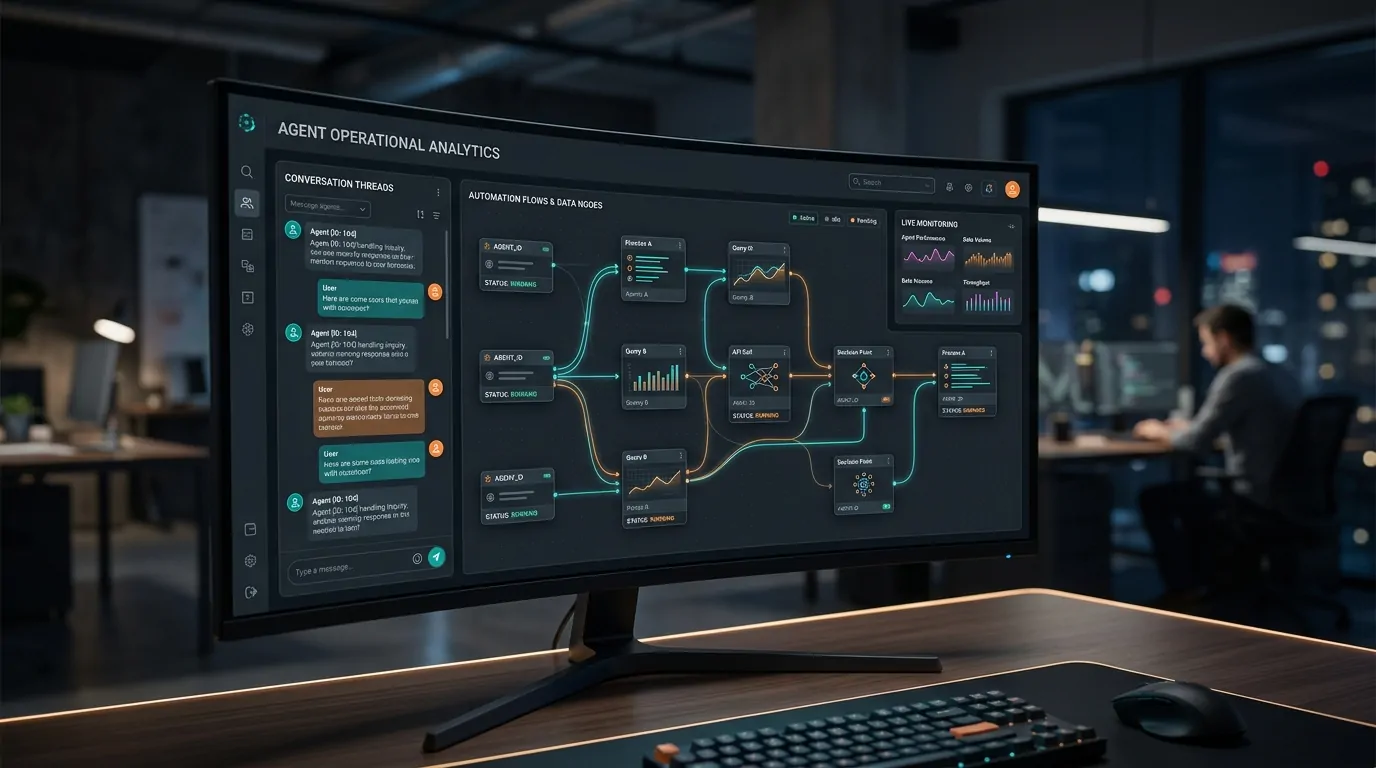
Agentic commerce: getting your catalog ready for AI buyers.

Most of the "AI in commerce" conversation is about chatbots on your side of the counter. The quieter, bigger shift is happening on the buyer's side: purchasing assistants that go looking for products and place the order themselves. This is an honest field note on what it takes to make a B2B catalog discoverable - and orderable - by those agents. It isn't a prediction piece: two distributors we run already publish live feeds. It's also not magic. The prerequisite is boring catalog hygiene, not a moonshot.
The next buyer might not be human
We run four AI agents in production today - a guest portal, a concierge, our in-house DM agent, and agentic-commerce feeds for B2B distributors. Three of those point at our side of the transaction. The fourth points the other way, and it's the one worth paying attention to, because it hints at where B2B buying is heading.
For years the assumption was that AI in commerce meant a smarter assistant helping your customer while they shopped your site. Agentic commerce inverts that. Increasingly the thing evaluating your catalog is software acting on the buyer's behalf - a purchasing assistant told "keep the kitchen stocked" or "reorder what we're low on at our contract price," that then goes and does it. The buyer never opens your storefront. They may never see your homepage at all.
That reframe matters because it changes what "being on the shortlist" means. A human buyer forgives a clunky site, phones your rep, muddles through. An agent does not. It consumes structured data or it moves on - and it never sends you a note explaining that you weren't in the consideration set.
"If your catalog isn't structured, fed and orderable in a way an agent can consume, you're not in the running - and nobody tells you you were skipped."
- The Silex Softwares team
Discoverable and orderable - both, or neither
There are two halves to being agent-ready, and half is worthless. An agent has to be able to find your product - match a need to your SKU, with the right specs, pack size and price - and then it has to be able to complete the order without a human stepping in. Miss either and you're a dead end.
Being findable but not buyable is the more common failure, and the more frustrating one. Your product shows up, the agent decides it fits, and then the path to purchase runs into a form that assumes a person, an account-pricing wall it can't negotiate, or a checkout that needs a phone call. The agent backs out and picks the competitor whose catalog let it finish the job.
In B2B the "buyable" half is where the real engineering sits, because B2B ordering is not retail. It's carton and case quantities, customer-specific price lists, contract terms, credit accounts and - for larger buyers - PunchOut into their procurement system. An agent-ready catalog has to carry all of that in a form software can act on, not just a pretty product page a human could read.
What actually makes a catalog agent-ready
None of this is exotic. It's the unglamorous work of getting your product data honest and keeping it that way. Three things do most of the work.
- Structured, clean product data. Consistent identifiers, real attributes (dimensions, pack size, specs), categories that mean something, and machine-readable structured data on your pages. An agent can only trust what it can parse - free-text descriptions and inconsistent units are where matching quietly fails.
- A live feed that stays current. A catalog snapshot from last quarter is a liability. The feed an agent reads has to be tied to the same source of truth as your storefront, so a discontinued line or a changed pack size is reflected everywhere at once, not eventually.
- Pricing and availability an agent can trust. The right price for that buyer - account-level, contract, or list - and stock the agent can rely on. A quoted price that's wrong at checkout, or an "in stock" that isn't, breaks the transaction and your credibility with the one buyer who never forgets.
The distributors already doing this didn't rebuild anything. They had clean, ERP-backed catalogs and extended the same data out as a feed an agent can consume. One is an Australian food-service wholesale distributor we've run for sixteen years: 56,000+ orders, carton ordering, customer-level pricing, 46 suppliers - and an agentic-commerce feed live in production. Carton reordering at account-specific pricing, placed by an assistant on the buyer's behalf, is not a slide in that account. It's a working path.
What's real today, and what's still hype
Here's the honest boundary. What's real: catalogs can be made discoverable, feeds can be published and kept current, and the "buyable" plumbing B2B needs - account pricing, carton quantities, PunchOut - already exists and works, because it's the same plumbing serious B2B stores have run for years. Two of our distributors publish live feeds now.
What's still early: buyer behaviour and the standards around it. The protocols for how agents discover and transact are still forming, adoption is uneven, and anyone promising fully autonomous end-to-end buying at scale today is overselling it. We wouldn't tell you an agent is going to replace your top accounts this year. We'd tell you the groundwork the wave needs is unglamorous data work you can start on now - and that betting on clean, well-structured data is a far safer bet than betting on any single protocol winning.
Why the ERP-sync work pays off twice
The best part is that the hard prerequisite isn't new work - it's work good B2B stores already had to do. The discipline that makes a catalog agent-ready is the same two-way ERP sync discipline that keeps human orders honest: one authoritative source for stock and price, changes reflected everywhere in real time, no drift between what the store says and what the warehouse knows.
An agent trusting your stock and your price is the exact same problem as your own checkout trusting them. If your storefront and your ERP already agree - inventory authoritative in the ERP, pricing resolved per account, orders flowing back cleanly - then extending that truth to an agent feed is a modest step, not a rebuild. It's the same reliability spine underneath every B2B e-commerce build we run. If they don't agree, an agent will surface the drift faster and less forgivingly than any human ever did. The reliability work you did for people is what earns an agent's trust; you get paid for it twice.
Do this before the wave, not during
Catalog hygiene is slow, boring, and easy to defer - which is exactly why starting now is an advantage. The distributors who get this right won't be the ones who move fastest when agentic buying goes mainstream. They'll be the ones whose data was already clean, whose feed was already live, whose pricing already resolved correctly per account before anyone was watching.
You cannot cram this during the wave. Cleaning up SKUs, fixing attributes, reconciling the feed to the ERP, wiring PunchOut for the accounts that need it - none of it is a weekend. Doing it now, calmly, while there's no pressure, is how you end up simply ready rather than scrambling. It's the same reason we run our own AI agents in production before we ever propose one to you: the boring groundwork has to be laid early, on your own risk, or it isn't there when it counts.
Start with a scoped pilot
You don't need an agentic-commerce strategy. You need one feed and one measurable outcome. Pick a slice of the catalog, publish a clean live feed tied to your real ERP truth, and prove that an agent can discover and order from it correctly at the right price. Learn what your data was quietly getting wrong. Then widen.
When we build these, they're self-hosted, on your own API keys, on your data - owned by you, no lock-in. That's how we run our own agents, and it's how we'd scope yours: one narrow, high-value workflow you can judge on real output, honest about what's live today and honest about what isn't. If you want to know whether your catalog is anywhere near agent-ready, that's exactly what a pilot is for.