7 B2B eCommerce Challenges US Distributors Need to Solve Before Launch
 By Sandeep Singh, Co-Founder · · 14 min read
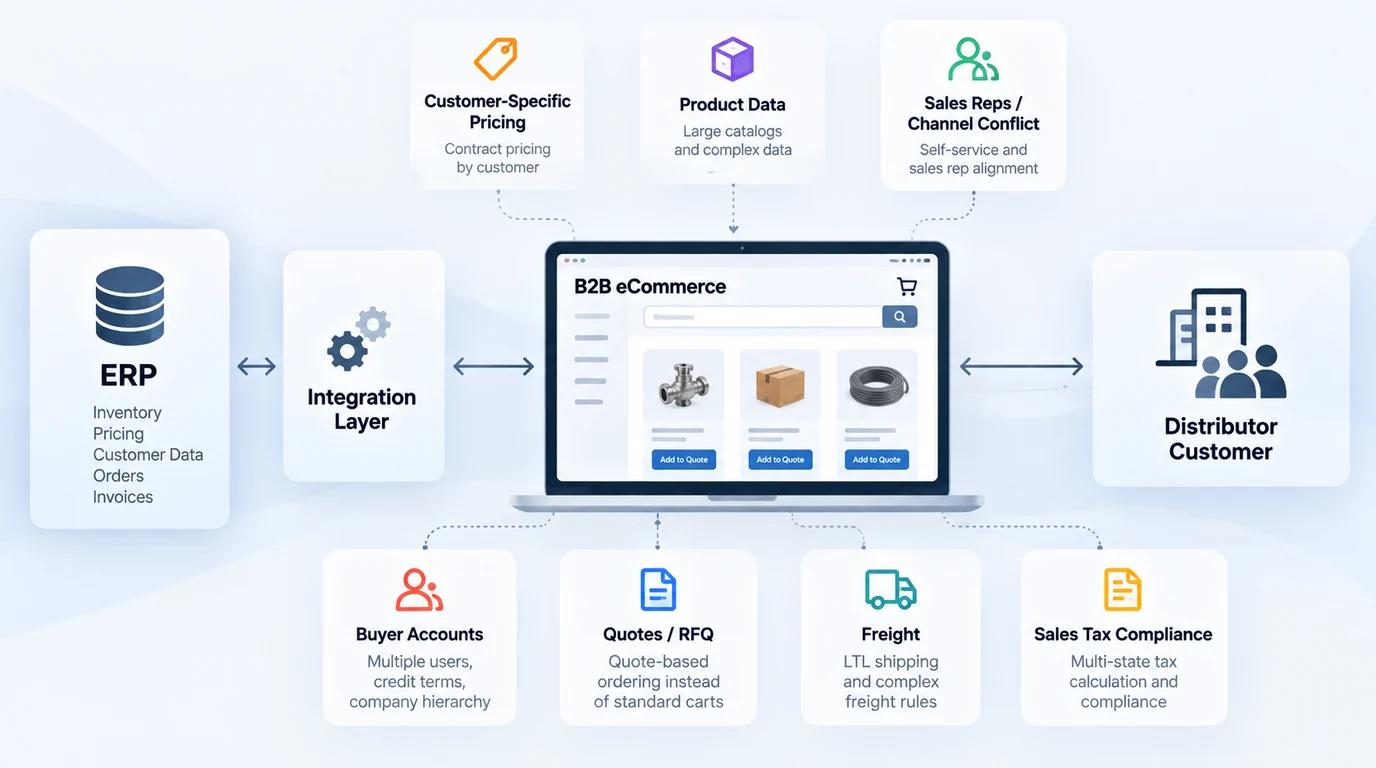
The short answer
US distributors face seven core B2B eCommerce challenges - ERP integration, customer-specific custom contract pricing, incomplete product data across large catalogs, sales rep channel conflict, company-level buyer accounts with credit terms, quote-based ordering instead of standard carts, and LTL freight with multi-state tax compliance. ERP integration causes the most budget overruns. Channel conflict causes the most failed launches. Before a distributor chooses an eCommerce platform or starts designing/building the website, they should first understand and document these seven challenges.
You have quotations from three agencies. One said $60,000 and four months. One said $280,000 and a year. A third wants a discovery phase before quoting anything. All three demonstrated a storefront that looked fine.
None of them showed you what happens when a customer with an already negotiated contract rate logs in at 9 a.m. and your field rep changed that rate at 8 a.m.
That gap is where B2B distribution eCommerce projects go wrong. The storefront is the easy part. Everything behind it is the project. The backend is where the real complexity lies - where the delays happen, orders get mixed up, and the quiet post-launch failure when the site goes live and nobody uses it.
The stakes are not small.
"A Gartner survey of 646 B2B buyers found 67% now prefer a rep-free buying experience, and 70% prefer a fully digital, self-service purchase. Your customers are going to buy this way. The question is whether they buy from you."
ERP Integration Is Where the Money Goes - Challenge 1
Your ERP is the system of record. Prophet 21, Acumatica, Infor SX.e, NetSuite, DDI, Sage 100/X3, or QuickBooks Enterprise. Inventory lives there. Pricing lives there. Open orders, invoices, credit holds, customer hierarchy, all of it.
A B2B eCommerce storefront that does not talk to that system properly is a brochure with a shopping cart bolted on.
1. Data That Has to Move, and in Which Direction
| Data | Direction | Required refresh |
|---|---|---|
| Inventory by warehouse | ERP → Site | Real time or near real time |
| Customer contract pricing | ERP → Site | Real time at login/cart |
| Product master + UOM | ERP/PIM → Site | Daily is acceptable |
| Customer accounts, credit status | ERP → Site | Real time |
| Orders | Site → ERP | Immediate |
| Order status, tracking, ship confirm | ERP → Site | Hourly or better |
| Invoices, open AR balance | ERP → Site | Daily minimum |
Silex built a Custom B2B eCommerce App as an integration layer between business systems and the eCommerce platform. It is designed to handle the data exchange and synchronization required across those systems.
2. The Real Reason Quotes Vary So Widely
Integration is a project within the project, not a single checkbox or budget line. Research from the Shopware partner ecosystem found 52% of total project effort in B2B eCommerce goes to integrations rather than frontend features. An agency quoting $60,000 has either priced a connector that does one-way inventory, or has not read your ERP's API documentation yet.
Forrester data cited by implementation teams puts ERP integration as the number one cause of go-live delays in 55% of B2B eCommerce projects. Panorama Consulting found 50% of ERP integrations fail to hit expected ROI, largely due to planning and execution, not technology.
3. The Nightly Batch Trap
The cheapest way to connect an ERP to an eCommerce website is a nightly file drop - meaning exchange files once a day, usually overnight. Inventory syncs at 2 a.m. and the site runs on that number all day.
A customer orders at 9 a.m. for an item a sales rep depleted at 8 a.m. The site shows 15 available. The ERP shows zero. The order goes through. Your CSR calls the customer to apologize. Do that four times and the buyer goes back to phoning the rep, permanently.
Every mismatch teaches the buyer that the rep is more reliable than the portal.
4. Middleware Is Not a Free Pass
iPaaS tools can reduce custom development by providing a mapping layer instead of custom development. But once the business logic gets specific, the complexity comes back. Pricing updates start failing, customer-specific discounts stop syncing, inventory counts drift, and the team spends more time troubleshooting middleware than selling.
The Custom B2B eCommerce App is an example of an iPaaS approach, providing an integration layer for connecting business systems and managing data exchange between them.
Middleware works well when your ERP has a clean, modern API and your pricing rules are simple. The integration becomes more complex when working with ERP-specific pricing logic, such as the matrix pricing used in Acumatica, P21, or SX.e.
5. What Should You Ask Before You Sign?
- Have you integrated this exact ERP version before? Ask for a relevant client case study.
- Is inventory real time, cached with a TTL, or batch? Get the number in writing.
- What happens to an order if the ERP is down at checkout?
- Who owns the integration after launch, and what is the monthly cost?
- Show me the error log and retry logic from a live client.
Customer-Specific Pricing Breaks Most B2B Platforms - Challenge 2
In distribution, list price is the price almost nobody pays. Each account has some combination of:
- Contract pricing - negotiated custom rates on specific items for a specific customer, often with an expiry date.
- Price tiers or classes - customer assigned to a level, with a discount off list or a markup over cost.
- Matrix pricing - customer class crossed with the product group, the Acumatica, P21 and SX.e standard.
- Quantity breaks - price drops at 10, 50, 250 units.
- Cost-plus - margin over landed cost, which moves when the manufacturer changes cost.
- Promotional or spot pricing - a temporary or one-off price approved by a sales rep.
The important point is what happens after login. Once a buyer is authenticated, the site should be able to show the price that applies to their account - not just reveal it at checkout. For anonymous visitors, showing a list price or "log in for pricing" can be perfectly appropriate when pricing is contract-based.
1. Where B2B Platforms Fall Down
| Pricing need | Common platform handling |
|---|---|
| Single price list per customer group | Supported almost everywhere |
| Per-SKU contract price per account | Often an add-on, an app, or custom |
| Matrix pricing (class × product group) | Rarely native, usually resolved via ERP call |
| Quantity breaks per customer | Partial support, frequently custom |
| Real-time cost-plus | Needs live ERP pricing calls |
The workable pattern is often a real-time price call to the ERP, with the result cached for the session. The storefront should not calculate the customer's price on its own. If a vendor proposes syncing a full price book to the site, ask how many rows that creates. A 200,000-SKU catalog across 400 accounts can mean tens of millions of price combinations. That is not a simple sync; without the right architecture, it can become an outage waiting to happen.
2. Non-Negotiable Checks
- Price shown on category pages, search results, and product pages, not only in cart.
- Expiry-dated contracts that fall off automatically.
- The rep and the portal show identical numbers on the same day.
- The customer's price should be retrieved quickly, in under 300 milliseconds, so the page does not stall (ERP should not slow down the website).
Product Data Is a Bigger Job Than the Website - Challenge 3
Most distributors carry between 50,000 and 500,000 SKUs. The catalog exists in the ERP as short alphanumeric fields: part number, description in 30 characters, weight, UOM, price. That is all the ERP was ever asked to store.
A buyer needs specs, photos, a datasheet, compatible parts, cross-references, and in regulated categories a current SDS.
1. The Four Data Problems, in Order of Pain
- Missing assets: No images on most SKUs. Manufacturer photos exist but sit in vendor portals in inconsistent formats and sizes.
- Thin descriptions: "BRKT MTG 3/8 ZN PLT" is fine for a picker. It fails for a buyer and fails completely for site search.
- Inconsistent attributes: Three manufacturers describe the same property as "Size", "Nominal Dia" and "OD". Faceted search cannot work across that.
- Unit of measure: One of the most expensive to get wrong.
2. The UOM Problem That Causes Returns and Margin Loss
| Field | Example | What goes wrong |
|---|---|---|
| Stocking UOM | EA (one piece) | ERP counts in each |
| Selling UOM | BX (12 EA) | Buyer thinks they ordered 12, gets 144 |
| Pricing UOM | C (per 100) | Price displays 100x off |
| Purchase UOM | CS (4 BX) | Availability math breaks |
Get the conversion factors wrong and you get chargebacks, returns and freight you eat. Every distributor who has launched a site has a story about the customer who ordered a pallet thinking it was a case.
3. The PIM Nobody Budgeted For
Product Information Management (PIM) - the product data is where the loss shows without ever appearing in a report. Forrester found more than 87% of shoppers have left a B2B site because product information was insufficient. Analysis of B2B digital revenue puts the cost of bad product data at 12-30% of digital revenue, lost through abandoned searches, avoidable sales calls and lost buyer confidence.
You will likely need a PIM. Budget for it before the platform decision, not after. And name the person who owns product data permanently. An unowned catalog decays within two quarters.
Channel Conflict Kills More Projects Than Code - Challenge 4
This one has nothing to do with software and sinks more builds than every technical issue combined.
1. The Sales Rep's Perspective
Your field sales team hears "eCommerce" and calculates the risk to their commission. So they do not mention the portal on calls. They keep taking orders by phone and email because that protects the relationship and the payout. Six months after launch, adoption is 4% and someone declares the project a failure.
The reps are not being difficult. Nobody changed the compensation plan, so nobody changed the behavior.
2. The Ownership Perspective
- Competitors will scrape our pricing.
- We will violate MAP (minimum advertised price) agreements with manufacturers.
- Our margin structure becomes visible to customers who currently do not compare.
3. How Distributors Actually Solve It
| Concern | Practical fix |
|---|---|
| Sales rep's commission loss | Credit online orders from assigned accounts to the rep at full or partial rate for at least 24 months |
| Sales rep sees portal as threat | Give reps order-on-behalf access so the portal becomes their tool |
| Price exposure | Login-gated pricing, list or "call for price" to anonymous visitors |
| MAP violations | Price visible only after authentication, with MAP-flagged SKUs suppressed publicly |
| Sales rep loses account visibility | Notify the rep when their customer orders online, with the order in their dashboard |
Pay representatives on online orders and see how resistance disappears in a quarter. Skip it and no amount of UX work will save adoption.
Research indicates 42% of ERP integration failures trace back to inadequate change management rather than technical problems. The technology is not the whole project. Getting your people to accept and use the new system is part of the project itself.
Buyer Accounts Are Companies, Not People - Challenge 5
A B2C account is one email and one card. A B2B account is an org chart with an AR (Accounts Receivable) balance attached.
1. Requirements for a Distributor Account
- Multiple users per company with separate logins.
- Roles - buyer, approver, AP clerk, read-only.
- Approval limits - orders over a set value route to a manager.
- Parent/child hierarchy - a chain with 40 branches, each ordering, one entity paying.
- PO number capture - mandatory, validated against format rules for some accounts.
- Multiple ship-to addresses - jobsites, branches, direct-to-customer.
- Credit terms - Net 30, Net 60, 2/10 Net 30.
- Credit limits and holds - the portal must block an order the ERP would block.
- Pay on account - not just card.
2. The AR Sync Problem
Most builds handle the organization chart and forget the money. A customer at their limit or on credit hold must not be able to place an order online. If the portal accepts it and AR rejects it later, you have created work for two teams and a bad experience for the buyer.
Card payments matter less here than people assume. Most distribution volume is terms-based. If your platform charges card fees on every transaction, run the math on a $40,000 order before you commit.
3. Adoption Features That Decide Whether the Site Gets Used
- Reorder from order history in one click
- Quick order pad by part number
- CSV or Excel upload of a part list
- Saved lists and standing orders
- Invoice lookup and PDF download without calling AR
Buyers who have ordered by phone for 20 years switch when the portal is faster than the phone. Not before.
Many of Your Orders Are Quotes, Not Carts - Challenge 6
A standard add-to-cart flow assumes a known price, a known availability and a known freight cost. In distribution, a meaningful share of orders have none of those.
1. Where the Cart Model Breaks
| Order type | Why checkout fails |
|---|---|
| Large-volume RFQ | Price is negotiated, not listed |
| Non-stock or special order | Lead time unknown until vendor confirms |
| Configured or cut-to-length | No fixed SKU exists |
| Freight-quoted LTL | Shipping cost cannot be calculated at checkout |
| Project or bid work | Buyer needs a formal quote document for their own approval |
2. Requirements for the Quote Workflow
- Add to quote as an alternative to add to cart, at line level
- Quote lands in the ERP, not only in the website database
- Inside sales prices and returns it with an expiry date
- Buyer accepts online and it converts to an order without rekeying
- Full quote history per account
A quote created in the ERP needs to be approvable and convertible to an order from the portal. If the quote lives only on the website, your inside sales team is doing double entry and will abandon it.
Freight and Tax Get Underestimated in B2B Platforms - Challenge 7
1. Freight
Parcel rating is solved. Distribution freight is not.
- LTL and truckload need live carrier rating by class, weight, dimensions and accessorials.
- Freight class varies by commodity and density, and a wrong class means a rebill you absorb.
- Accessorials - liftgate, residential, inside delivery, limited access - must be captured at checkout, not discovered at delivery.
- Drop-ship from multiple vendors means one order becomes three shipments from three origins.
- Split shipments across your own warehouses need the site to decide what ships from where.
- Will-call and branch pickup need to be a real checkout option with branch selection.
Many distributors launch with "freight quoted separately" and a callback. That is honest and it works, but it removes self-service from exactly the orders where it would save the most labor. Plan the path from manual quoting to live rating.
2. Sales Tax
Physical presence used to define the obligation. After South Dakota v. Wayfair, revenue does.
Forty-five states plus DC each set their own economic nexus threshold, and a seller can owe tax in a state they have never visited, triggered by sales volume alone. The most common threshold is $100,000 in sales, with Alabama at $250,000 and California, Texas and New York at $500,000. More than 15 states have dropped their transaction-count trigger, but revenue tracking per state is still required.
3. The Exemption Certificate Problem
Most of your customers are resellers and pay no sales tax. That only holds if you have a valid, current, correctly formatted certificate for each one, in each state.
- Certificates expire and states have different validity periods.
- Multi-state customers need a certificate per state.
- An audit with missing certificates means you owe the tax, plus penalties and interest, often looking back three to five years.
Automate it. Avalara, Vertex or TaxJar with certificate management attached. The subscription costs less than one audit assessment.
Before Choosing a B2B eCommerce Platform
Use these seven challenges as a checklist when you evaluate any platform. At a minimum, make sure it handles ERP integration, customer-specific pricing, company accounts and credit terms, RFQ workflows, product data management, freight and tax calculation, and sales-rep attribution.
Knowing how to choose a B2B eCommerce platform for US distributors comes down to how well it fits the way your business actually runs, and a polished vendor demo won't show you that. Before you commit, run each requirement through real scenarios from your own operation, like a contract customer reordering at their negotiated price, a large quote that needs approval, or a mixed-freight order shipping to several states.
Frequently Asked Questions
How much does a B2B eCommerce site cost for a distributor?
Mid-market builds with real ERP integration generally run $75,000 to $350,000 for implementation, plus $2,000 to $15,000 monthly for platform, integration maintenance, tax automation and PIM. Quotes under $50,000 usually exclude integration depth, data work, or both.
How long does it take?
Six to twelve months for a first launch with ERP integration, contract pricing and a cleaned catalog. Faster is possible when the ERP is Acumatica with a modern API and the catalog is under 10,000 SKUs.
Which ERP integrates most easily with eCommerce?
NetSuite and Acumatica have the most mature APIs. Prophet 21 and Infor SX.e have established integration patterns but usually need a specialist partner. Older DDI and on-premise Sage installs require the most custom work.
Will an online store cannibalize my sales reps?
Not if reps are credited for online orders from their accounts. Distributors that pay commission on portal orders typically see reps become the strongest driver of adoption, because the portal handles reorders and frees the rep for higher-value work.
Do I need a PIM?
Below roughly 5,000 SKUs from a handful of suppliers, a well-structured platform catalog can hold. Above that, with feeds from multiple manufacturers in different formats, a PIM saves more in labor than it costs within the first year.
What should I look for in a B2B eCommerce platform as a distributor?
Evaluate against twelve requirements: ERP integration, customer-specific pricing, company accounts with roles, credit management, RFQ workflow, quick order, PIM capability, LTL freight, tax integration, sales rep attribution, multi-warehouse inventory and quote-to-order conversion. Make the vendor demonstrate each one in a live client environment.
What does a B2B eCommerce architecture look like?
The ERP stays the source of truth and connects through an integration layer to the eCommerce platform, supported by a PIM for product content, a tax engine for multi-state compliance, a freight rating service for LTL, a payment layer that handles both cards and pay-on-account, and analytics across the whole flow.
What KPIs should a distributor track after launch?
Online order penetration, self-service order percentage, portal adoption by account, cost per order by channel, CSR order-entry hours, pricing and order error rates, reorder rate, quote-to-order conversion and quote turnaround time. Self-service percentage matters more than online revenue percentage, because it separates genuine buyer adoption from rep-entered orders.
Sources
- Gartner - Gartner Sales Survey Finds 67% of B2B Buyers Prefer a Rep-Free Experience (survey of 646 B2B buyers, Aug-Sep 2025)
- Razoyo - The B2B Ecommerce ERP Integration Problem Nobody Talks About Until It's Too Late
- OroCommerce - PIM in B2B eCommerce (citing Forrester on insufficient product information)
- Commenda - Sales Tax Thresholds: A Guide for Online Sellers & Ecommerce (verified against Sales Tax Institute, July 2026)
- Reveation Labs - Why B2B eCommerce Projects Fail and What to Do About It
- B2Sell - B2B Ecommerce Integration: Why Middleware Falls Short