AI for Vacation Rentals: What Should Your Guest Agent Handle?
 By Jitender Saini, Co-Founder · · 16 min read
The short answer
What should an AI guest agent handle for a vacation rental?
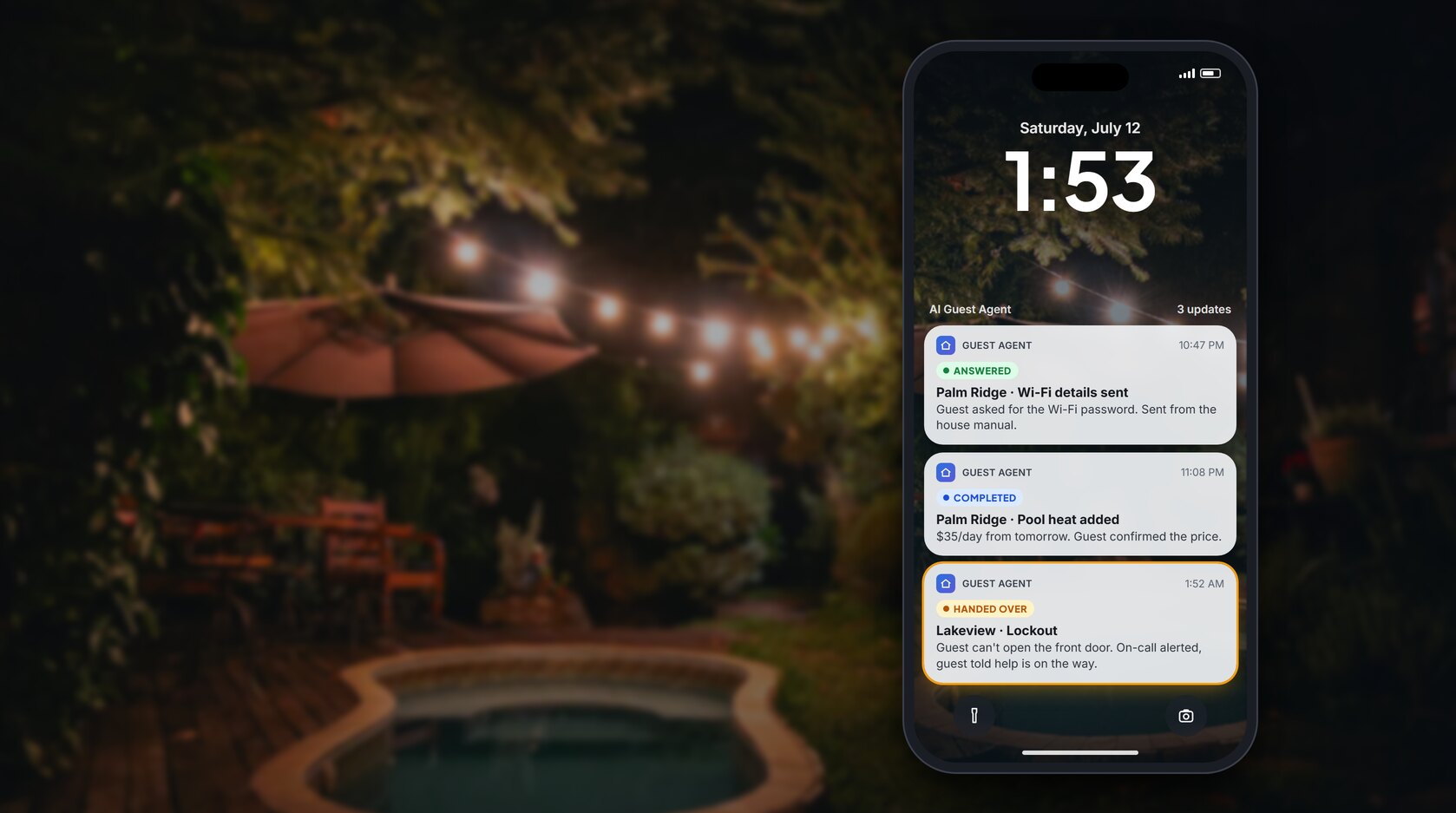
An AI guest agent should answer any question your property data already answers, complete requests with a fixed price and a clear rule once the guest agrees, and hand anything involving safety, money or judgment to your team. In practice, that means it handles access, house rules, amenities and simple add-ons, and your staff handle lockouts, damage, refunds and complaints.
Key takeaways
- Sort every guest message into one of three groups: answer, complete or hand over. The tests for each are below.
- An AI agent can only answer correctly from data you give it. Most wrong answers trace back to an old code, a changed rule or a missing price.
- Requests like pool heat, late checkout or a date change can be completed end to end, as long as the guest confirms the price first.
- Door and gate codes go only to a verified guest, for their own booking, close to check-in. Never put codes in the agent's instructions.
- Start with a person approving the agent's replies, then let it work alone on each type of message once it has proved accurate.
What is an AI guest agent, and how is it different from auto-replies?
Chances are you already send scheduled messages. Check-in details go out three days before arrival, the checkout reminder the night before. Nothing wrong with that. But a scheduled message has no idea what the guest just asked.
Chatbots do read the question. Then, most of the time, they tell the guest how to sort it out themselves. An agent opens the booking, checks the house and sorts it out for them.
| What it does | Template auto-replies | Chatbot | AI guest agent |
|---|---|---|---|
| Sends check-in instructions on a schedule | Yes | Yes | Yes |
| Understands a question worded in a new way | No | Yes | Yes |
| Looks up this guest's booking | No | Sometimes | Yes |
| Changes something in your system (adds a request, moves a date) | No | No | Yes |
| Knows when to stop and alert a person | No | Rarely | Yes, by rule |
Here's a real one. 11:42 p.m., a guest messages: can we move to Friday instead? A chatbot would explain the change process and leave it there. The guest agent we built for an Orlando-area operator looks at the calendar and the change policy (operator's rule book) first. Friday's open, the policy allows it, so it moves the booking and sends the confirmation. Nobody on the team wakes up. Had the policy needed sign-off, the guest would have been told someone will confirm in the morning, and the request would be waiting in the team's queue.
How do you decide what the agent handles? The three-group test
Clients always want to know what their agent should be allowed to do. So we take their guest messages, kind by kind, and ask three questions. In this order, because the first one overrides the rest.
- Could anyone get hurt, lose money or feel they've been treated unfairly? Then a person handles it. Stop there.
- Is the answer written down somewhere for this property? Then it's the agent's to answer.
- Is there a fixed price, a written rule and a person who actually does the job? Then the agent can finish it, once the guest agrees.
Some messages won't fit any of the three. Those go to a person too. Keep a list of them, though. Each one is a rule you haven't written yet, or a fact missing from the property file.
| Group | What it means | Examples |
|---|---|---|
| Answer | The reply already exists in your property data | Wi-Fi, parking, checkout time, pool rules, trash day |
| Complete | The agent completes the task after the guest says yes | Pool heat, early check-in, late checkout, date change, extra cleaning |
| Hand over | A person decides; the agent acknowledges and alerts | Lockouts, injuries, damage, refunds, complaints, storms |
What can an AI guest agent handle at each stage of a stay?
What guests ask about shifts a lot between the week before arrival and the morning they leave.
| Stage | What guests send | Agent's role |
|---|---|---|
| Before booking | "Is it free for July 4th week?" "Can we bring the dog?" "Does it really sleep 12?" | Answers from the calendar and listing; passes discount requests and group bookings to a person |
| Before arrival | "What's the gate code?" "Can we get in at noon?" "Is there a crib?" "Can you heat the pool?" | Answers and finishes requests; sends codes close to check-in |
| During the stay | "Wi-Fi's down." "How does this thermostat work?" "More towels please." "The dishwasher's leaking." | Answers and runs first checks; dispatches or alerts for repairs |
| Checkout | "Do we strip the beds?" "Can we stay till 1?" "Where do the keys go?" | Answers and finishes late checkout requests |
| After the stay | "My kid left his tablet." "When do we get the deposit back?" | Logs lost items; passes deposit and damage questions to a person |
And the messages don't all come through one door. Our Orlando-area client's platform talks to more than 12 channels, Airbnb, Booking.com, Vrbo and Expedia among them. If an agent only covers some of those, your team ends up working two inboxes, which is worse than one.
Which guest questions can it answer on its own?
If your staff would answer by copy-pasting from the house manual, so can the agent.
Getting in: codes, lockboxes, gates
"How do we get in?" comes up before almost anything else. Get it wrong and a family with tired kids is standing in a driveway at midnight. Explaining how entry works is fine at any hour.
The actual code is a different story. We'd only send it to a guest who can be matched to the booking, for example because they're logged into the guest portal. Only for their own home, too, and only in the day or two before they arrive.
Where the code lives matters too. Keep it in the booking record and have the agent read it from there. People do try to talk AI tools out of their rules, sometimes by claiming to be the owner, sometimes a "VIP guest." If the codes were never in the agent's instructions, there's nothing to talk it out of.
House rules, occupancy and the HOA
Rules questions tend to arrive as very specific asks:
- "Can my sister's family join us Saturday?" (occupancy)
- "Can we bring the boat?" (parking, trailers, RVs)
- "Is music on the patio OK at 11?" (quiet hours)
- "Our dog's 60 pounds, is that a problem?" (pets)
- "What time does the clubhouse pool close?" (HOA and building rules)
Store these per home. Two houses on the same street can belong to different HOAs with different parking rules, and a guest who gets the wrong one may come back to a warning sticker, or a towed car. You'll hear about it either way.
Amenities and how things work
- The Wi-Fi name, and the password with the 0s and Os spelled out
- Which remote runs the TV and which one is for the soundbar
- How to light the grill, start the hot tub, work the smart lock
- Where the beach chairs, bikes or ski racks are kept
A few lines per home covers most of this, plus a photo for anything fiddly. The 10 p.m. "how do I turn the TV on?" message is a good one to never see again.
Local information
- Real drive times from that address, not "about 20 minutes"
- The closest supermarket that's open late, a 24-hour pharmacy, urgent care
- Which day the bins go out, and which bin is which
When an agent doesn't have one of these and fills the gap anyway, the guest is the one who finds out.
First-line troubleshooting
Before you send anyone out, the agent can take the guest through the obvious checks:
- Wi-Fi down: unplug the router for 30 seconds
- One room without power: here's where the breaker panel is
- AC blowing warm: is the thermostat on "cool" or "fan"?
- Lock won't open: press the lock button after the code; if the keypad's dark, it's the battery
Cap it at two or three checks. After that the agent should send someone or ping your team, because a guest on vacation didn't come for tech support.
Which guest requests can it complete?
Finishing a request takes some groundwork. Decide the price, write the rule, and name who does the work. After that the agent can have the conversation, get the guest's yes, and drop the job into the same queue your team already works from.
Pool heat and other paid extras
Pool heat is a good example because it's simple and it makes money. This is how the agent we run for our Orlando-area client handles it:
- A guest logged into the guest portal asks: "Is pool heat available?"
- The agent checks the property and answers yes.
- The guest says they want it.
- The agent checks whether heat comes with that home or costs extra.
- It costs extra here, so the agent quotes the daily price and asks if they're happy to go ahead.
- Guest says yes. Pool heat goes onto the booking, and the team sees it in their list.
Same pattern, different extras:
- Early check-in or late checkout, if cleaning can fit around it
- A mid-week clean, or just fresh sheets
- Pet fee, crib, high chair
- A second parking pass, where the HOA allows one
- Beach chairs, bikes, ski gear, whatever you rent out
Per extra, the agent needs three facts. When can you offer it, what does it cost, and how much notice does your team want?
Changing a booking
Moving dates, adding a night, two more guests. The agent can handle these if your change policy exists as an actual rule, not just in your reservations manager's head. It checks the calendar against the policy and tells the guest the difference in price. Once the guest okays it, the booking gets updated. Inside your cancellation window, or anything the policy doesn't cover? A person decides.
Guests who don't write in English
Language is one area where an agent clearly earns its keep. The AI concierge we built for a luxury villa operator in Europe and Türkiye sells in five languages: English, Turkish, Russian, Slovenian and German. In the US you'll mostly see Spanish and Québécois French. Whatever the language, get a native speaker to read through a pile of the agent's replies before it goes solo.
What should it always hand to your team?
Safety, money and judgment calls are for people. With these, the agent replies fast so the guest knows someone's on it, and then gets the message to the right person.
Not everything in this group is equally urgent, so we split it up:
| Urgency | Examples | What the agent does |
|---|---|---|
| Emergency | Injury, fire, gas smell, flooding, someone in the pool who shouldn't be | Tells the guest to call 911, gives your emergency line, alerts on-call immediately |
| Urgent, same hour | Lockout, no AC in summer, no heat in winter, no water, power out | Acknowledges, runs any safe first checks, alerts on-call |
| Same day | Broken appliance, hot tub not heating, noise complaint from a neighbor | Acknowledges, logs a work order or alerts the manager |
| Next business day | Refund or discount request, damage report, deposit question, review threat | Acknowledges, says when a person will reply, passes the full conversation on |
When the agent hands something over, your team shouldn't have to scroll back through the whole thread. It should pass along:
- Which booking, which house
- Two or three lines on what's wrong
- What the agent already said to the guest
- How fast someone needs to act
Why should an AI guest agent never offer money on its own?
If your agent promises a refund, expect to pay it. In 2024 a Canadian tribunal made Air Canada honor a discount its website chatbot had invented (Moffatt v. Air Canada). Air Canada's defense was that the chatbot was responsible for what it said. The tribunal didn't buy it.
In a vacation rental, you can see these moments coming:
- "The pool was cold when we got here. Can we get a night back?"
- "We're staying ten nights, is there a discount?"
- "The place wasn't clean. We want a refund."
- "Any chance you'd skip the pet fee? He's tiny."
Our answer is blunt. The agent doesn't offer refunds, discounts or waived fees, and it doesn't agree to them either. It writes down what the guest asked and sends it to a person. It also never adds a charge until the guest has said yes to a stated price, which is exactly how the pool heat flow above works.
Our agents log every action they take. So if a guest later says "your agent told me…", you can pull up exactly what it did say.
What changes for vacation rentals in Florida?
The three groups don't change in Florida. The amount of local detail does. Around Orlando, Kissimmee and Davenport, guests ask things a cabin in Colorado never hears:
- Gates. One community has a keypad, the next has a guard house with a guest list, a third wants you to pick up a pass at the clubhouse. The agent needs to know which is which.
- HOA rules. No boats in the driveway. Bins back in by evening. Wristbands for the resort pool. Two cars, max.
- Pool heat. Usually extra. The Kissimmee listings we looked at charged $32 to $35 a day with 1 to 7 days' notice, and a pool can need a full day or more to warm up. With each home's price and notice rule, the agent can tell a guest arriving tomorrow whether the water will be warm in time.
- Theme parks. "How long to Disney?" gets asked constantly. Same for Universal and SeaWorld. Store the drive time for each address.
- Heat and storms. No AC in August is an emergency in all but name, and an afternoon thunderstorm can kill the power for hours. Hurricane season runs June 1 to November 30. Cancellations, rebooking and evacuation questions always go to a person, together with your written storm policy.
Every market has its version of this list. A beach condo gets asked about parking permits and where the chairs are. A mountain cabin gets snow tires, hot tub covers and wood stoves. Whatever your market, get the local answers written down for each home before you switch the agent on.
How should you roll out AI agents for vacation rentals?
Slowly, at first. Our first agent for a client took 4 to 8 weeks, and for the first stretch a person approves every reply before it goes out.
- Gather the property facts. How to get in, house and HOA rules, occupancy, how things work, local info, the price and notice for each extra. Your busiest homes first.
- Write down the rules. What's the change policy? What can the agent finish alone? What does it pass on, and to whom, at 2 p.m. versus 2 a.m.?
- Draft mode. The agent writes, a person approves (human judgement plays an imperative role), edits or bins it. This is where you find the holes in your data, quickly.
- Let it answer. Once the replies in the answer group barely need touching, let it send those itself.
- Then let it finish requests. One kind at a time. We like late checkout first, then pool heat, then date changes.
- Read its conversations every week. Note what stumped it, fix the data, tweak the rules.
Changing booking systems at the same time? Finish that first. The agent is only as good as the property and booking data underneath it. We wrote up the order of work in Switching Vacation Rental Software: A Week-by-Week Plan.
How do you know the agent is working?
Pick a handful of numbers on day one and compare them with the month before launch:
| Measure | What it tells you |
|---|---|
| First reply time, day and night | Whether guests are waiting less |
| Share of messages handled without a person | How much work the agent takes off your team |
| Hand-over rate by type | Which message types still need rules or data |
| Wrong-answer rate (from your weekly review) | Whether the data behind the agent is accurate |
| Revenue from extras the agent sold | Whether finishing requests is paying off |
| Guest review mentions of communication | Whether guests notice the difference |
In the first few weeks, the wrong-answer rate is the one to watch. Fix the bad fact behind a wrong answer once, and that question stops going wrong.
Should you buy a tool or own your agent?
Off-the-shelf AI messaging tools mostly charge per listing, per month. The published prices we found ran from about $6 to $12 a listing (HostAI, Besty AI). Easy to start with. Then you add twenty homes and the bill goes up with them.
The other route is an agent built into your own platform, running on your own AI account. That's how we build ours: self-hosted, on the client's own API key, with whichever AI provider they pick, Anthropic Claude or OpenAI for example. The client pays the provider directly for what they use. If they ever leave us, the prompts, the data and the agent go with them.
Whichever you pick, get straight answers to these:
- Who owns the conversation history and the property knowledge, and can you export them?
- Is guest data used to train the vendor's AI models?
- Does it cover every channel your guests message on?
- Can it act in your booking system, or only reply?
- Can you set what it may do alone and what needs approval?
- Is every action logged?
FAQ
Is AI guest messaging safe for vacation rentals?
It can be. Three things make the difference: the agent answers only from your property data, codes go only to verified guests for their own booking, and anything about safety, damage or money goes to a person. When we've seen an agent get something wrong, the data behind it was out of date, an old code or a rule that had changed.
Can an AI guest agent take payments for add-ons?
It can quote the price, get the guest's okay and add the request to the booking. Collecting the money depends on your booking and payment system. Either way, nothing gets added until the guest has agreed to a stated price.
Should guests know they're talking to AI?
We'd tell them. California and Utah both have rules about disclosing AI in customer conversations, and other states may follow. Ask your lawyer which ones apply to you.
Will an AI guest agent replace my guest service team?
No. It picks up the repeat questions and the small requests, which mostly land at night and on weekends anyway. Lockouts, repairs, complaints and money stay with your people. Those are also the conversations guests still remember when they sit down to write a review.
Does an AI guest agent work with Airbnb, Vrbo and Booking.com messages?
It can, if it connects to those channels directly or through your booking system. Ask before you sign up for anything. An agent that only covers the chat box on your website misses most of what guests send.
How long does it take to set up?
Our first agents usually go live in 4 to 8 weeks, starting in draft mode with a person approving replies. Most of that time goes on gathering property data and wiring into your booking system. The AI part is the quick bit.
Get help setting up an AI guest agent
Silex builds vacation rental software and runs AI agents for vacation rental operators, among them a guest service agent for an Orlando-area operator and an AI concierge for a luxury villa operator in Europe and Türkiye. If you'd like one set up around your homes, your rules and your booking system, book a free assessment.
Sources
- Silex Softwares - Orlando-area vacation rental operator case study (AI guest portal, 12+ channels)
- Silex Softwares - Luxury villa operator case study (AI concierge in five languages)
- American Bar Association - BC tribunal confirms companies remain liable for information provided by AI chatbot (Moffatt v. Air Canada, 2024 BCCRT 149)
- HostAI and Besty AI - published per-listing pricing, October 2026
- NOAA National Hurricane Center - Atlantic hurricane season, June 1 to November 30
- ITIF - New state laws in Utah and California require businesses to disclose AI interactions